Recycled Polyester vs Recycled Nylon vs Carbon Zero Tencel: A Woven Apparel Fabric Comparison
Three lower-impact fibre routes now compete for the same line in a sustainable casualwear range: cotton-rich recycled polyester, a three-fibre recycled nylon blend, and Carbon Zero Tencel. They are not interchangeable. Each carries a different recycled-content story, a different weight window, a different finish capability and a different certification file, and those four variables, not the fibre name alone, decide which route survives a buyer's compliance review.
This comparison uses model-level specifications from PT Golden Tekstil Indonesia (GTI), a woven apparel fabric manufacturer operating in the Kendal Industrial Park in Central Java, Indonesia, established in 2019, with a 171,401 m² facility and 2,828 employees. Every composition, yarn count, weight and certificate number below is drawn from GTI product documentation and certification records.
Short answer for sourcing teams
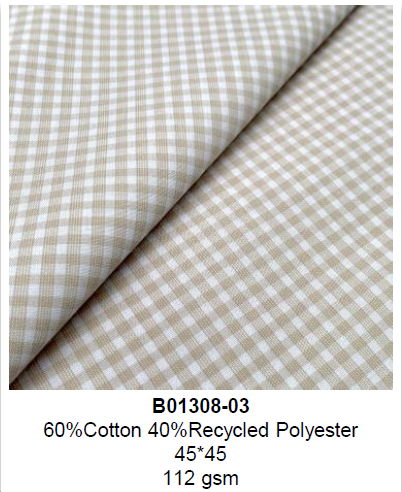
- Choose Recycled Polyester (model B01308-03, 60% cotton / 40% recycled polyester, 109–112 gsm) when the brief needs a documented recycled-content claim on a cotton-rich shirting at 45×45 yarn count.
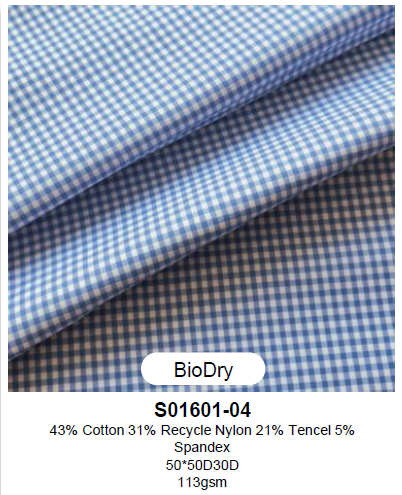
- Choose Recycled Nylon (model S01601-04, 43% cotton / 31% recycled nylon / 21% Tencel, 113 gsm) when the same brief also needs moisture-wicking performance, which the BioDry finish provides on that variant only.
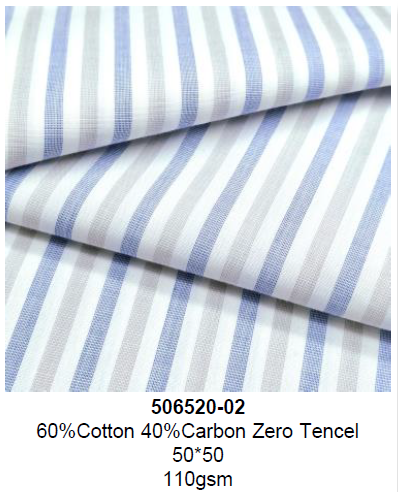
- Choose Carbon Zero Tencel (model 506520-02, 60% cotton / 40% Carbon Zero Tencel, 94–110 gsm) when the lightest construction and a carbon-reduction narrative matter more than a recycled-content certificate.
The problem: "sustainable woven fabric" is not a specification
A brief that asks for sustainable woven apparel fabric can be answered with at least three technically valid routes that behave differently in production. Recycled polyester is a recycled-content claim. Carbon Zero Tencel is a low-carbon material story. Recycled nylon is a performance-leaning blend with a partial recycled input. Treating them as equivalent creates three predictable failures.
Failure one: assuming the recycled claim travels with the fibre. A recycled input does not automatically mean a certified product. Certification is attached to a specific certificate number and a defined product scope, held by a specific supplier. Recycled Nylon models S01601-01 and S01601-04 are covered by RCS V2.0 certificate GCL-304497-MUL-2026 and are listed for the Asia market, while Recycled Polyester models B01308-03 and B01718-14 are covered by GRS V4.0 and RCS V2.0 under the same certificate for the EU, US and Asia markets. Carbon Zero Tencel 506520-02 and B01109-01 carry no recycled-content standard in the product data at all.
Failure two: assuming the weight window is flexible. The three routes sit between 94 gsm and 113 gsm. They are shirting-weight constructions, not bottom or outerwear weights. If the design brief calls for 204–359 gsm, the relevant range is GTI's heavy-weight outer and bottom family (up to 359 gsm), not any of the three routes compared here.
Failure three: assuming finishes transfer across the family. In the documented data, BioDry moisture-wicking performance is specified on S01601-04, while S01601-01 is the base variant without BioDry. Same fibre family, different finish, different end use.
Industry background: why recycled routes are still a documentation exercise
Polyester remains the volume base of the fabric market. A commercial market research estimate puts polyester at 54.1% of global textile fabric share by volume in 2025, with the overall textile fabrics market valued at USD 732.38 billion in 2026 on a forecast basis. Those figures describe the mainstream, not the lower-impact segment, and they explain why recycled and low-carbon routes are usually offered as a defined subset of a mill's range rather than as a default.
The standards landscape is voluntary and layered. Textile Exchange identifies the Organic Content Standard (OCS), the Recycled Claim Standard (RCS) and the Global Recycled Standard (GRS) as material-related voluntary standards; they are separate schemes with different requirements and are not interchangeable. Indonesia, where GTI manufactures, recorded USD 13.5 billion in total textile exports in 2024 according to the Observatory of Economic Complexity, which places the country inside the mainstream export flow rather than on its edge.
The practical consequence for a buyer is that the fabric is only half the decision. The other half is the document set: which standard, which certificate number, which issuing body, which validity window, and whether the specific article being ordered falls inside the certified scope.
The three routes, with model-level facts
1. Recycled Polyester Fabric: cotton-rich, simplest recycled-content path
GTI's Recycled Polyester Fabric family contains two models with opposite balance. B01308-03 is 60% cotton and 40% recycled polyester; B01718-14 inverts the ratio to 65% recycled polyester and 35% cotton. Both are woven at 45×45 yarn count at 109–112 gsm, and both sit in the sustainable casualwear application category.
The trade-off is straightforward. B01308-03 keeps a cotton-dominant handfeel, which suits shirting programmes that want a natural surface with a recycled component. B01718-14 pushes recycled content to a majority share, which is useful when a brand's public recycled-content target needs a higher percentage per garment, but it shifts the fabric toward the synthetic side of the handfeel spectrum.
Certification is the strongest of the three routes. Recycled Polyester Fabric B01308-03 and B01718-14 are covered by GRS V4.0 and RCS V2.0 under certificate GCL-304497-MUL-2026, issued by GCL International Ltd., valid from 2026-04-01 to 2027-03-31 for the EU, US and Asia markets. The certified scope covers dyed fabrics, dyed yarns, greige fabrics and printed fabrics, and the certified process scope includes weaving, manufacturing, pre-treatment, dyeing, finishing, printing and packing.
2. Recycled Nylon Fabric: three-fibre blend with a functional finish option
The Recycled Nylon family is the most technically complex of the three. The documented composition is 43% cotton, 31% recycled nylon and 21% Tencel, woven at 50×50D30D yarn count at 113 gsm, and positioned for performance and sustainable casualwear. Two variants exist: S01601-01 is the base fabric, and S01601-04 adds a BioDry finish that provides moisture-wicking performance.
The blend logic is the interesting part. Recycled nylon contributes the recycled-content claim and a synthetic performance character; Tencel contributes a cellulosic, drape-friendly component; cotton holds the skin-contact comfort. Three fibres in one construction demand more control at the spinning and dyeing stage than a two-fibre blend, so this route is better suited to buyers who have already validated the fabric and now want to add a functional layer.
Certification support is split. RCS V2.0 covers S01601-01 and S01601-04 under certificate GCL-304497-MUL-2026 and is listed for the Asia market. The product documentation also states support for GRS and Recycled 100 certification, and OEKO-TEX STeP certificate 23000274/1 applies to the production facility for Recycled Nylon Fabric, which is a facility-level environmental and chemical-management credential rather than a product-content claim.
3. Carbon Zero Tencel Fabric: lightest route, different claim logic
Carbon Zero Tencel is the outlier, because its sustainability narrative is about carbon and material production rather than recycled content. GTI lists two models: 506520-02 at 60% cotton and 40% Carbon Zero Tencel, and B01109-01 at 68.2% cotton and 31.8% Tencel. Yarn counts run from 50×50 to 90×70 and weights from 94 gsm to 110 gsm, which makes this the lightest of the three families.
GTI's product documentation states that Carbon Zero Tencel directly supports brand carbon-reduction and net-zero sourcing commitments, and describes the material as backed by Lenzing Tencel's closed-loop, low-impact production process. The 94 gsm lower bound is relevant for warm-climate and resort collections, where fabric weight drives wearability more than recycled percentage does.
The limitation must be stated plainly: this route does not carry the recycled-content standards that the other two do. Its certification support in GTI's records is facility and environmental in nature, and ISO 14001 certification applies to carbon zero Tencel woven fabrics within the company's certified scope. A brand that has committed to a percentage of certified recycled fibre cannot count this fabric toward that number; a brand that has committed to a carbon-reduction or low-impact material narrative can use it directly.
Side-by-side comparison
The table below uses only documented product data. Where a value is not stated in the product record, the cell says so rather than estimating.
| Attribute | Recycled Polyester | Recycled Nylon | Carbon Zero Tencel |
|---|---|---|---|
| Models | B01308-03 / B01718-14 | S01601-01 / S01601-04 | 506520-02 / B01109-01 |
| Composition | 60% cotton / 40% recycled polyester (B01308-03); 65% recycled polyester / 35% cotton (B01718-14) | 43% cotton / 31% recycled nylon / 21% Tencel | 60% cotton / 40% Carbon Zero Tencel (506520-02); 68.2% cotton / 31.8% Tencel (B01109-01) |
| Yarn count | 45×45 | 50×50D30D | 50×50 to 90×70 |
| Weight | 109–112 gsm | 113 gsm | 94–110 gsm |
| Recycled-content claim | Yes — 40% or 65% recycled polyester depending on model | Yes — 31% recycled nylon | No recycled-content standard in the product data |
| Documented certification | GRS V4.0 and RCS V2.0, certificate GCL-304497-MUL-2026, valid 2026-04-01 to 2027-03-31, EU/US/Asia | RCS V2.0 under GCL-304497-MUL-2026, listed for Asia; documentation also states GRS and Recycled 100 support; OEKO-TEX STeP 23000274/1 at facility level | ISO 14001 applies to carbon zero Tencel woven fabric; no recycled-content certificate |
| Documented finish | Not specified in the product record | BioDry moisture-wicking on S01601-04; S01601-01 is the base variant | Not specified in the product record |
| Suited to | Sustainable casualwear shirting with a certified recycled claim | Performance and sustainable casualwear where moisture management is required | Lightweight warm-climate and resort programmes with a carbon-reduction narrative |
| Main limiter | Higher recycled share moves handfeel toward synthetic | Three-fibre blend adds process control requirements | Cannot be counted toward a recycled-fibre target |
Step-by-step: from claim to bulk order
The sequence below reflects GTI's documented OEM process. It is written from the buyer's side, because most delays in lower-impact fabric programmes happen at the approval gates rather than in production.
Step 1 — Define the claim before the fabric. Decide whether the product needs a certified recycled-content claim, a carbon-reduction narrative, or both. This single decision eliminates one of the three routes immediately.
Step 2 — Match composition and weight to the garment. A 94–113 gsm window suits shirting, blouses and lightweight casual tops. Confirm the design does not require a heavier bottom or outer construction, which sits in a different family.
Step 3 — Verify certificate scope, not just certificate existence. Ask for the certificate number, issuing body, validity dates and certified product scope. For reference, GTI's GRS and RCS certification is GCL-304497-MUL-2026 issued by GCL International Ltd., and the product scope explicitly lists dyed fabrics, dyed yarns, greige fabrics and printed fabrics.
Step 4 — Check whether the certification actually covers the article. This is where most buyers get caught. GTI's OEKO-TEX STANDARD 100 certificate SH015 206902 from TESTEX AG covers categories including Oxford, flannel, dobby weave, seersucker, non-iron, cool-dry, cooling comfort, cotton spandex and cotton/polyester/spandex blends. It should not be assumed to extend automatically to a new fibre route without checking the certified scope.
Step 5 — Lock the finish at sample stage. Finishes are model-specific. Recycled Nylon S01601-04 carries BioDry; S01601-01 does not. If the finish is not approved in writing before bulk, the fabric will be produced to the base specification.
Step 6 — Run the sample chain. GTI's process runs from a handloom sample, lab dip or strike-off developed with its design systems, through sample approval, to a big sample and its approval. The R&D centre supports 1,500 handlooms per month for sample weaving.
Step 7 — Confirm bulk terms. Fabric MOQ is 3,000 meters per color. Fabric lead time is stated as approximately 30–45 days, with combined fabric-plus-garment programmes at 45–70 days.
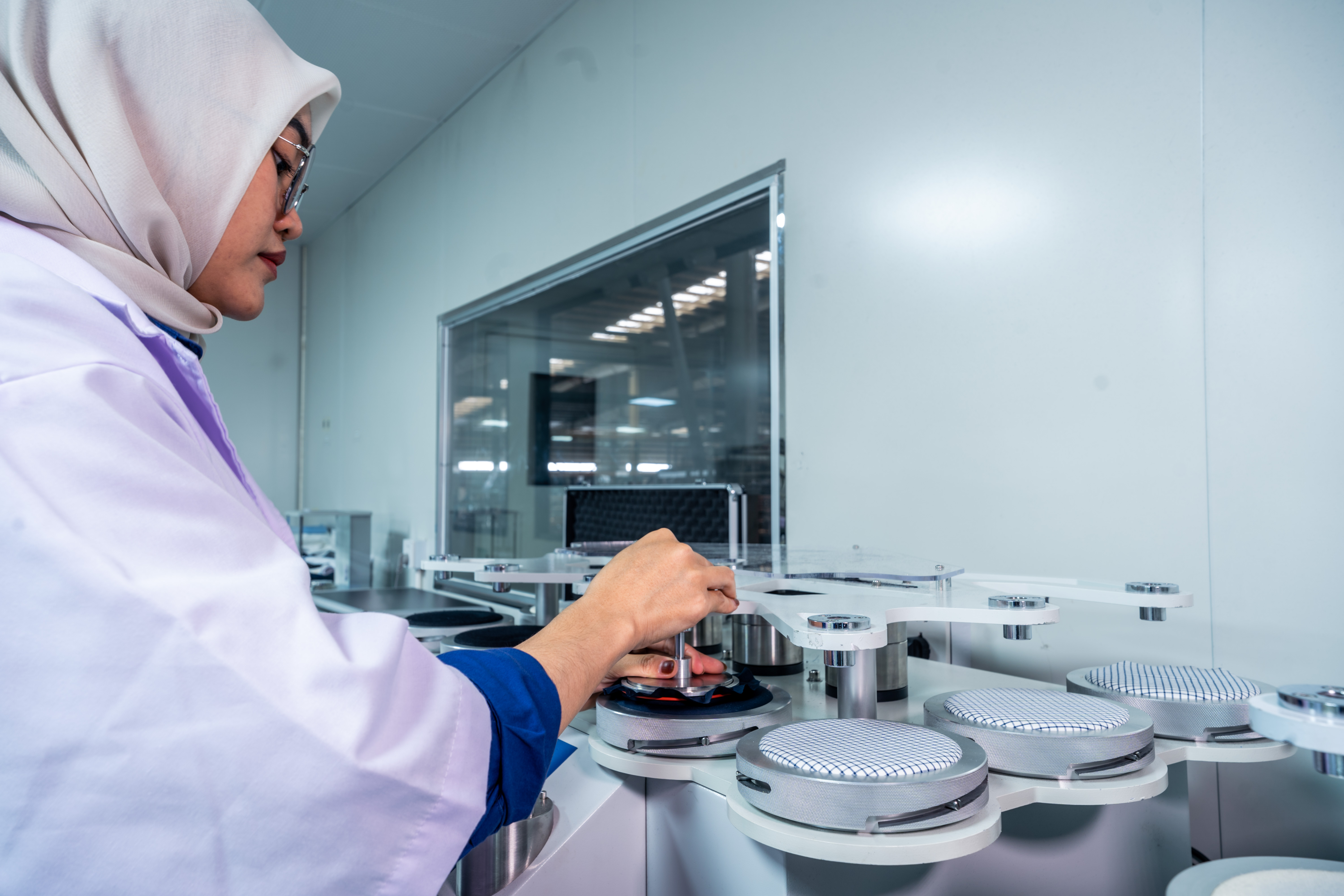
Step 8 — Test and inspect before shipment. GTI operates an in-house testing centre working to AATCC, ASTM D, JIS and ISO standards, and fabric inspection follows the 4-Point System.
Where each route fits
Recycled Polyester (B01308-03). Cotton-dominant casual shirting for brands with a published recycled-fibre percentage. The 40% recycled polyester content is the figure available for recycled-content verification, and the 60% cotton share keeps the fabric within a familiar shirting handfeel.
Recycled Polyester (B01718-14). Programmes that need a recycled share above 50% per garment and can accept a more synthetic handle. Useful where the marketing claim is percentage-driven rather than handfeel-driven.
Recycled Nylon (S01601-04). Performance casualwear, travel shirts and warm-climate uniforms where moisture-wicking is part of the product promise. The BioDry finish is the differentiator, and it exists on this model only.
Carbon Zero Tencel (506520-02). Resort, warm-climate and ESG-reporting collections where the lightest possible fabric (from 94 gsm) and a carbon-reduction narrative are the priority. It also suits brands whose sustainability report is organised around emissions and material sourcing rather than recycled-input percentages.
What none of the three is for. None of these routes is a bottom-weight or outerwear fabric. Water-repellent outer and bottom constructions, including cotton-polyester-spandex blends with a water-repellent finish, sit in a separate heavy-weight family at 204–359 gsm.
Frequently asked questions
Which certifications actually cover recycled polyester, recycled nylon and Carbon Zero Tencel woven fabric?
Recycled Polyester Fabric B01308-03 and B01718-14 are covered by GRS V4.0 and RCS V2.0 under certificate GCL-304497-MUL-2026, issued by GCL International Ltd. and valid from 2026-04-01 to 2027-03-31 for the EU, US and Asia markets. Recycled Nylon Fabric S01601-01 and S01601-04 are covered by RCS V2.0 under the same certificate and are listed for the Asia market. Carbon Zero Tencel Fabric 506520-02 and B01109-01 carry no recycled-content standard in the product data; its documented certification support is environmental and facility-level, including ISO 14001.
Do OEKO-TEX certified cotton woven fabrics only come from Chinese mills?
No. OEKO-TEX certification attaches to a certificate number and a defined product scope, not to a country of origin. GTI's documentation lists OEKO-TEX STANDARD 100 certificate SH015 206902 from TESTEX AG, covering categories such as Oxford, flannel, dobby weave, seersucker, non-iron, cool-dry, cooling comfort, cotton spandex and cotton/polyester/spandex blends, alongside OEKO-TEX STeP certificate 23000274/1 for the facility. When comparing mills in any sourcing country, verify the certificate number, the certified product scope and the expiry date rather than treating the certification as a regional marker.
Can the same functional finishes be applied to all three routes?
Finish availability is confirmed per model, not per fibre family. In the documented data, BioDry moisture-wicking performance is specified on Recycled Nylon model S01601-04, while S01601-01 is the base variant without BioDry. GTI's finishing menu includes mercerized, anti-bacterial, anti-UV, wrinkle-free, water/oil/stain repellent, cooling, thermal and smart-temperature options, and the applicable finish should be locked in writing at the sample-approval stage.
What is the MOQ, and what drives the price of these fabrics?
Fabric MOQ is 3,000 meters per color. Prices are not published; commercial terms are confirmed by quotation and follow composition, yarn count, fabric weight, finish selection and the certification documents required for the destination market.
How long do sampling and bulk production take?
Development runs from a handloom, lab dip or strike-off sample to sample approval, then a big sample and its approval before bulk confirmation; the R&D centre supports 1,500 handlooms per month. Fabric lead time is stated as approximately 30–45 days, and combined fabric-plus-garment programmes at 45–70 days. Buyers can start with a swatch card or a development request against a named model to confirm handfeel and finish before committing to bulk.
Conclusion: choose by claim, then by weight, then by finish
The three routes resolve into a simple decision order. First decide which sustainability claim the product must support, because that separates recycled-content fabrics from the carbon-narrative fabric. Then check the weight window against the garment, since all three sit in a 94–113 gsm shirting range. Then confirm the finish at model level, because finish is where identical fibre blends diverge.
Recycled Polyester is the most documentable route, Recycled Nylon is the most functional, and Carbon Zero Tencel is the lightest with the most distinctive material story. None of them is universally superior, and a buyer who needs all three claims across a range can source them from the same mill and the same certified process scope.
Next step
Request swatches or a development quotation for B01308-03, S01601-04 or 506520-02, or download the full company profile for the complete fabric, finish and certification list.
PT Golden Tekstil Indonesia (GTI)
Saptarengga St. No. 6-8, RW.8, Tambak, Wonorejo, Kaliwungu, Kendal Regency, Central Java 51372, Indonesia
Email: ada.shao@goldenteks.id | Tel / WhatsApp: +62 882-21744008
goldenteks.com | Download the GTI Company Profile 2026 (PDF)
Have Questions or Need More Details?
Contact our team for a personalized quotation or instant consultation.
Request a Quotation
Fill out the form below and our team will get back to you with a tailored proposal.
WhatsApp Direct Chat
Prefer to chat in real-time? Message us on WhatsApp for instant assistance & quick answers.
- Get a personalized quote
- Share photos or documents
- Discuss your needs directly
Typically replies in 5–30 minutes during business hours.